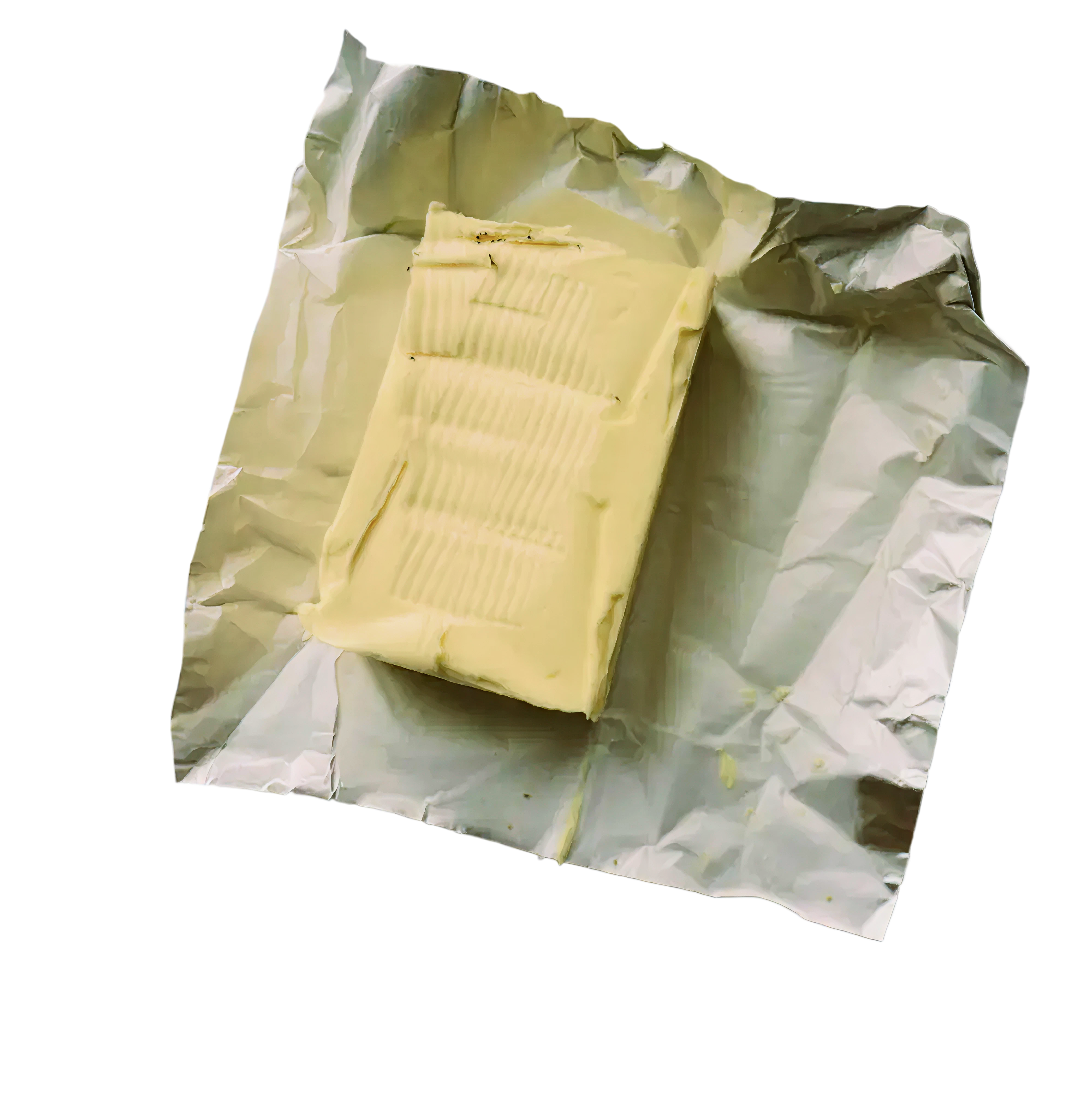
What does butter taste like?
February 13, 2026
Since moving back to Montreal three years ago, I noticed an emerging craft aesthetic in Quebec. A number of products, but especially drinks and beer, are flavoured with wild herbs, grasses, and seeds. I became curious about the origins of these flavours. My favourite is mélilot — sweet clover — sometimes nicknamed “boreal vanilla.” When dried, it develops a coumarin aroma that tastes of hay and vanilla.
Boreal butter >
"During the summer, cows should be fed on pasture. However, in the province of Quebec, because of the winter freezes and thaws which severely damage the pastures … and also because of the frequent droughts during the summer … Green forages and meadow grasses are not always sufficiently rich in protein, especially at the end of the summer season."
The emphasis in these guides is on forage diversity and seasonal adaptation. Contemporary feed systems, by contrast, are often standardized for efficiency and yield. Industrial livestock systems rely on formulated feed and veterinary interventions that decouple animals from local forage ecologies. In such systems, a cow’s diet can become increasingly independent of its immediate landscape.
What we've lost can be qualified in flavour but reaches much more deeply into the industrialization of animals and the land they're reared on.
Even back in 1894, the Gazette des Campagnes lamented the aroma of butter:
Many butters lack flavor because the plants that dairy cows eat do not contribute to it and cannot impart to the butter a fragrance that would make it desirable to buyers.
It proposed a solution:
Here, it seems, is a way to give butter the fragrance it lacks, using certain forage herbs that cows eat, such as sweet clover (white and yellow), sweetgrass, and woodruff.
The answer to "What does butter taste like?" could come from the grass-fed butter movement. L'Ancêtre states that its cows graze "outside whenever the weather allows and benefit from high-quality feed, primarily consisting of organic forage." Other large producers tout the benefits of grass without specificity of flavour. Broadly, the claim is that the dairy tastes better, but not in a "flavour design" way for example, that the wine world would recognize.
If you would like to transport yourself back to 1894 and see what a foraged-enhanced butter might taste like, here is a recipe ripped from the headlines:
A calico (cotton cloth) bag filled with these herbs [white and yellow mélilot, sweet vernal grass, and woodruff] is suspended in an empty and carefully closed churn. When churning the cream, the bag is removed and replaced with four similar small bags attached to the churn's wings. These wings, by beating the cream, give it, and consequently the butter, a highly prized aroma.
For the stand mixer instructions, or to taste this butter, you'll need to stay tuned and attend one of our events in the spring! Until then, happy butter, and thanks for reading!
Get more articles like this one in your inbox
Subscribe
What does butter taste like?
February 13, 2026
Since moving back to Montreal three years ago, I noticed an emerging craft aesthetic in Quebec. A number of products, but especially drinks and beer, are flavoured with wild herbs, grasses, and seeds. I became curious about the origins of these flavours. My favourite is mélilot — sweet clover — sometimes nicknamed “boreal vanilla.” When dried, it develops a coumarin aroma that tastes of hay and vanilla.
Boreal butter >
"During the summer, cows should be fed on pasture. However, in the province of Quebec, because of the winter freezes and thaws which severely damage the pastures … and also because of the frequent droughts during the summer … Green forages and meadow grasses are not always sufficiently rich in protein, especially at the end of the summer season."
The emphasis in these guides is on forage diversity and seasonal adaptation. Contemporary feed systems, by contrast, are often standardized for efficiency and yield. Industrial livestock systems rely on formulated feed and veterinary interventions that decouple animals from local forage ecologies. In such systems, a cow’s diet can become increasingly independent of its immediate landscape.
What we've lost can be qualified in flavour but reaches much more deeply into the industrialization of animals and the land they're reared on.
Even back in 1894, the Gazette des Campagnes lamented the aroma of butter:
Many butters lack flavor because the plants that dairy cows eat do not contribute to it and cannot impart to the butter a fragrance that would make it desirable to buyers.
It proposed a solution:
Here, it seems, is a way to give butter the fragrance it lacks, using certain forage herbs that cows eat, such as sweet clover (white and yellow), sweetgrass, and woodruff.
The answer to "What does butter taste like?" could come from the grass-fed butter movement. L'Ancêtre states that its cows graze "outside whenever the weather allows and benefit from high-quality feed, primarily consisting of organic forage." Other large producers tout the benefits of grass without specificity of flavour. Broadly, the claim is that the dairy tastes better, but not in a "flavour design" way for example, that the wine world would recognize.
If you would like to transport yourself back to 1894 and see what a foraged-enhanced butter might taste like, here is a recipe ripped from the headlines:
A calico (cotton cloth) bag filled with these herbs [white and yellow mélilot, sweet vernal grass, and woodruff] is suspended in an empty and carefully closed churn. When churning the cream, the bag is removed and replaced with four similar small bags attached to the churn's wings. These wings, by beating the cream, give it, and consequently the butter, a highly prized aroma.
For the stand mixer instructions, or to taste this butter, you'll need to stay tuned and attend one of our events in the spring! Until then, happy butter, and thanks for reading!
Get more articles like this one in your inbox
Subscribe
What does butter taste like?
February 13, 2026
Since moving back to Montreal three years ago, I noticed an emerging craft aesthetic in Quebec. A number of products, but especially drinks and beer, are flavoured with wild herbs, grasses, and seeds. I became curious about the origins of these flavours. My favourite is mélilot — sweet clover — sometimes nicknamed “boreal vanilla.” When dried, it develops a coumarin aroma that tastes of hay and vanilla.
Boreal butter >
"During the summer, cows should be fed on pasture. However, in the province of Quebec, because of the winter freezes and thaws which severely damage the pastures … and also because of the frequent droughts during the summer … Green forages and meadow grasses are not always sufficiently rich in protein, especially at the end of the summer season."
The emphasis in these guides is on forage diversity and seasonal adaptation. Contemporary feed systems, by contrast, are often standardized for efficiency and yield. Industrial livestock systems rely on formulated feed and veterinary interventions that decouple animals from local forage ecologies. In such systems, a cow’s diet can become increasingly independent of its immediate landscape.
What we've lost can be qualified in flavour but reaches much more deeply into the industrialization of animals and the land they're reared on.
Even back in 1894, the Gazette des Campagnes lamented the aroma of butter:
Many butters lack flavor because the plants that dairy cows eat do not contribute to it and cannot impart to the butter a fragrance that would make it desirable to buyers.
It proposed a solution:
Here, it seems, is a way to give butter the fragrance it lacks, using certain forage herbs that cows eat, such as sweet clover (white and yellow), sweetgrass, and woodruff.
The answer to "What does butter taste like?" could come from the grass-fed butter movement. L'Ancêtre states that its cows graze "outside whenever the weather allows and benefit from high-quality feed, primarily consisting of organic forage." Other large producers tout the benefits of grass without specificity of flavour. Broadly, the claim is that the dairy tastes better, but not in a "flavour design" way for example, that the wine world would recognize.
If you would like to transport yourself back to 1894 and see what a foraged-enhanced butter might taste like, here is a recipe ripped from the headlines:
A calico (cotton cloth) bag filled with these herbs [white and yellow mélilot, sweet vernal grass, and woodruff] is suspended in an empty and carefully closed churn. When churning the cream, the bag is removed and replaced with four similar small bags attached to the churn's wings. These wings, by beating the cream, give it, and consequently the butter, a highly prized aroma.
For the stand mixer instructions, or to taste this butter, you'll need to stay tuned and attend one of our events in the spring! Until then, happy butter, and thanks for reading!
Get more articles like this one in your inbox
Subscribe